
Aerial Doombot
Common · Artifact Creature — Robot Villain · At the table
Aerial Doombot costs one blue mana; on its entry turn its power-up costs five generic mana.
The set’s mechanics with worked examples, then every word on the cards.
Each power-up ability can be activated once. On the turn its permanent entered, reduce the activation cost by that permanent’s mana cost.
Aerial Doombot costs one blue mana; on its entry turn its power-up costs five generic mana.
As an optional additional casting cost, tap untapped creatures whose total power reaches the printed teamwork number.

A two-power blocker can pay teamwork 2 after blocks, improving Helicarrier Strike without removing the blocker from combat.
Each Plan’s own text says how to gain counters and what completing the Plan does.

The Cube rewards second-card draws before its final counter; evaluate that recurring token production too.
Draw, then discard; a discarded nonland gives the conniving creature a +1/+1 counter.

Compare keeping your next land drop with making a larger attacker.
Choose a face when casting. A printed transform ability can later change the permanent to its other face.

Decide whether a cheap first face helps your curve or whether the other face deserves the mana.
For Mjölnir’s equip ability, a creature must be legendary, red or white (or both), and not a Villain.

Count actual legal equip targets before treating the hammer as a payoff.
Harnessing an Infinity Stone enables the ability printed after its infinity symbol while it stays on the battlefield.

Choose an enter-effect permanent to reuse with The Mind Stone’s end-step trigger.
Every word on the cards and in the deck plans, defined once. Find a term, read its wording, then see it on a card.
A flavor label with no independent rules meaning. Follow the ability text printed after this label; a different label does not change how that text works.
A +1/+1 counter adds one power and one toughness; a −1/−1 counter subtracts one of each. These counters stay until removed or the object changes zones.
Watch out: If a permanent has both kinds, matching pairs are removed as a state-based action. A temporary +1/+1 effect is not a counter.
A flavor label with no independent rules meaning. Follow the ability text printed after this label; a different label does not change how that text works.
Activate this ability only if this creature attacked this turn, and only once each turn. It need not have dealt combat damage.
A flavor label with no independent rules meaning. Follow the ability text printed after this label; a different label does not change how that text works.
A flavor label with no independent rules meaning. Follow the ability text printed after this label; a different label does not change how that text works.
A flavor label with no independent rules meaning. Follow the ability text printed after this label; a different label does not change how that text works.
Draw, then discard; a discarded nonland gives the conniving creature a +1/+1 counter.
While paying for this spell, each untapped creature you tap can cover one generic mana, or one mana of that creature’s color.
Watch out: You may tap a creature you just played. A colorless creature can cover only generic mana.
A flavor label with no independent rules meaning. Follow the ability text printed after this label; a different label does not change how that text works.
To counter a spell or ability is to remove it from the stack without its effects resolving. A countered spell normally goes to its owner’s graveyard.
Watch out: This use of “counter” is different from placing a marker such as a +1/+1 counter on a card.
Tap other untapped creatures you control with enough total power to turn this Vehicle into an artifact creature until the turn ends.
Watch out: The crew creatures do not become the Vehicle’s attackers. A newly played Vehicle still needs haste to attack that turn.
Enough useful low-cost plays to act before your expensive threats.
A flavor label with no independent rules meaning. Follow the ability text printed after this label; a different label does not change how that text works.
From your hand, pay the cycling cost and discard this card to draw a card.
Watch out: Cycling is an activated ability, not casting the card. Typecycling searches for a specified kind of card instead.
Any positive amount of damage this source deals to a creature is enough to make that damage lethal.
Watch out: It works with a fight or other noncombat damage. Indestructible still prevents destruction.
This creature cannot attack.
Watch out: It can still block and use its abilities unless something else prevents that.
While paying the spell’s cost, exile cards from your graveyard to pay one generic mana each. Delve cannot pay colored costs.
A flavor label with no independent rules meaning. Follow the ability text printed after this label; a different label does not change how that text works.
A flavor label with no independent rules meaning. Follow the ability text printed after this label; a different label does not change how that text works.
Move a permanent from the battlefield to its owner’s graveyard because an effect or lethal damage destroys it.
Watch out: Indestructible stops destruction. Sacrificing, exiling, and reducing toughness to 0 are different ways for a creature to leave.
As this permanent enters, you may sacrifice creatures; it enters with the stated number of +1/+1 counters for each one. A devour variant may restrict which permanents can be sacrificed.
Move a card from your hand to your graveyard.
Watch out: Discarding is not casting. It does not pay the card’s mana cost or produce its normal spell effect.
Follow what is being doubled. Doubling power or toughness adds a modifier based on its current value; doubling counters adds as many of that kind as are already present.
This creature deals combat damage in the first-strike damage step and again in the normal damage step if it is still in combat.
Watch out: If its blocker dies in the first step, a blocked attacker does not hit the player in the second step unless an ability such as trample allows it.
A flavor label with no independent rules meaning. Follow the ability text printed after this label; a different label does not change how that text works.
An Aura’s enchant line tells you what it may be attached to.
Watch out: An Aura cast as a spell targets what it will enchant. If it later becomes illegally attached, it normally goes to the graveyard.
An ability-word label for abilities that trigger when this creature is dealt damage. Follow the effect printed after the label.
Pay the equip cost to attach this Equipment to a target creature you control. Normally, activate equip only in your main phase when the stack is empty.
Watch out: The Equipment usually stays on the battlefield when the creature leaves. Moving it to another creature normally costs another equip activation.
Move the object to the exile zone. It is separate from the graveyard.
Watch out: A card in exile cannot normally be played. You need a rule or effect giving permission, such as a resolved Adventure.
A flavor label with no independent rules meaning. Follow the ability text printed after this label; a different label does not change how that text works.
Whenever you cast a spell, you may pay one white or black mana for each extort trigger. Each paid trigger makes each opponent lose 1 life and gains you the total life lost this way.
The two creatures each deal damage equal to their power to the other at the same time.
Watch out: This is not combat. First strike and double strike do not add damage steps; deathtouch and lifelink still affect damage.
If a permanent with a finality counter would go from the battlefield to a graveyard, exile it instead.
Watch out: It does not die when this replacement sends it to exile, so ordinary “dies” abilities do not trigger.
This creature deals combat damage in an earlier step, before creatures without first strike or double strike.
Watch out: A creature killed in that early damage step usually cannot deal its normal combat damage.
You may cast this spell when you could cast an instant, including during another player’s turn when you have priority.
Watch out: Flash changes when you may cast it. It does not let you cast from a different zone or avoid its costs.
You may cast this instant or sorcery from your graveyard by paying its flashback cost.
Watch out: Follow its normal timing. A spell cast with flashback is exiled when it leaves the stack, even if it is countered.
An attacking creature with flying can be blocked only by creatures with flying or reach.
Watch out: A flying creature can block a creature without flying.
A standard Food token is an artifact with an ability costing two mana, tapping it, and sacrificing it to gain 3 life.
Watch out: Food is also an artifact type. Turning a card into a Food follows that effect’s text; the type alone does not grant an ability.
A Food token is an artifact with “{2}, {T}, Sacrifice this token: You gain 3 life.” Printed Food cards can have other abilities.
A flavor label with no independent rules meaning. Follow the ability text printed after this label; a different label does not change how that text works.
Harnessing an Infinity Stone enables the ability printed after its infinity symbol while it stays on the battlefield.
This creature may attack and use abilities with the tap or untap symbol even if you have not controlled it since your turn began.
Watch out: It still needs to be untapped to attack or pay a tap cost.
Remove all damage marked on the indicated creature. Healing does not remove counters or return a creature that has already died.
A permanent with hexproof cannot be targeted by spells or abilities its controller’s opponents control.
Watch out: Its controller may target it. Effects that do not target can still affect it.
Each split mana symbol can be paid using either half. For example, {W/U} costs one white or one blue mana; {2/B} costs two mana of any type or one black mana.
Watch out: Choose separately for each symbol. A {W/U} card is both white and blue even if you use only one color to cast it.
A flavor label with no independent rules meaning. Follow the ability text printed after this label; a different label does not change how that text works.
While paying for the spell, tap untapped artifacts to pay one generic mana each. This does not pay colored mana costs.
This permanent cannot be destroyed by lethal damage or an effect that says “destroy.”
Watch out: It can still be exiled or sacrificed. A creature with toughness 0 or less still goes to the graveyard.
A flavor label with no independent rules meaning. Follow the ability text printed after this label; a different label does not change how that text works.
Create a Clue artifact token. Its two-mana, tap-free sacrifice ability draws a card.
A keyword counter grants its named ability, such as trample, to the object it is on.
Watch out: A trample counter is not a +1/+1 counter. The named ability and the creature’s size are separate.
This label groups abilities that reward a land entering under your control. The rest of each card tells you its effect.
Watch out: A land entering from a spell can trigger landfall too. The label itself adds no rules; read the actual ability.
A flavor label with no independent rules meaning. Follow the ability text printed after this label; a different label does not change how that text works.
When this source deals damage, its controller gains that much life at the same time.
Watch out: This also works for noncombat damage. It uses the damage actually dealt, not simply the creature’s printed power.
This attacking creature cannot be blocked by just one creature; at least two blockers are needed.
Watch out: It can still go unblocked. Losing one blocker after blocks are declared does not undo the original block.
A flavor label with no independent rules meaning. Follow the ability text printed after this label; a different label does not change how that text works.
Put the stated number of cards from the top of the named player’s library into that player’s graveyard.
Watch out: Milling is not drawing. An empty library makes you lose when you must draw from it, not merely when its last card is milled.
A flavor label with no independent rules meaning. Follow the ability text printed after this label; a different label does not change how that text works.
Choose a face when casting. A printed transform ability can later change the permanent to its other face.
A flavor label with no independent rules meaning. Follow the ability text printed after this label; a different label does not change how that text works.
A flavor label with no independent rules meaning. Follow the ability text printed after this label; a different label does not change how that text works.
A flavor label with no independent rules meaning. Follow the ability text printed after this label; a different label does not change how that text works.
Each Plan’s own text says how to gain counters and what completing the Plan does.
Choose a creature token you control and create a token copy of it. If you control no creature token, you create nothing.
Each power-up ability can be activated once. On the turn its permanent entered, reduce the activation cost by that permanent’s mana cost.
Whenever you cast a noncreature spell, this creature gets +1/+1 until the turn ends.
Watch out: Lands are not spells. The prowess trigger can resolve even if the spell that triggered it is countered.
A flavor label with no independent rules meaning. Follow the ability text printed after this label; a different label does not change how that text works.
This creature may block creatures with flying.
Watch out: Reach does not give it flying or make its own attacks harder to block.
If cast from your hand, this spell exiles itself as it resolves. At your next upkeep you may cast it from exile without paying its mana cost. A countered spell does not rebound.
Create a shield for the next time this permanent would be destroyed this turn: instead tap it, remove its marked damage and remove it from combat. This cannot prevent sacrifice or death from zero toughness.
Roles are Aura enchantment tokens with different printed effects. Read which Role the card creates; the tokens are not interchangeable.
Move a permanent you control from the battlefield to its owner’s graveyard.
Watch out: Sacrifice is not destruction: indestructible does not stop it. You cannot sacrifice a teammate’s permanent unless an effect specifically permits it.
A Saga normally enters with a lore counter and gains another as your first main phase begins. Reaching chapter numbers triggers those chapter abilities.
Watch out: The new lore counter is not added during upkeep. When its final chapter ability is no longer on the stack, you normally sacrifice the Saga.
Look at the stated number of cards from the top of your library. Put any number on the bottom and the rest back on top, choosing their order.
Watch out: Scry does not draw a card. Cards you move to the bottom do not go to the graveyard.
A flavor label with no independent rules meaning. Follow the ability text printed after this label; a different label does not change how that text works.
A creature with shadow can block only creatures with shadow and can be blocked only by creatures with shadow.
Repeated useful late cards may suggest an open color; one card is weak evidence.
During your declare-blockers step, cast for the sneak cost and return an unblocked attacker you control to hand. A creature cast this way enters tapped and attacking the same player or permanent.
A flavor label with no independent rules meaning. Follow the ability text printed after this label; a different label does not change how that text works.
A flavor label with no independent rules meaning. Follow the ability text printed after this label; a different label does not change how that text works.
Choose one or more modes as you cast this spell and add the printed extra cost for every mode chosen. You cannot choose one mode repeatedly.
A flavor label with no independent rules meaning. Follow the ability text printed after this label; a different label does not change how that text works.
If a permanent with a stun counter would untap, remove one stun counter instead and leave it tapped.
Watch out: The counter does not tap an untapped permanent by itself. Several stun counters can stop several separate untaps.
The actual cards and mana that let a payoff work.
Look at the stated number of cards from the top of your library. Put any number into your graveyard and the rest back on top in your chosen order.
Watch out: Surveil does not draw a card. Unlike scry, unwanted cards go to the graveyard instead of the bottom.
A flavor label with no independent rules meaning. Follow the ability text printed after this label; a different label does not change how that text works.
Tap means turn a permanent sideways; untap means return it upright. A tap symbol in a cost means you must tap that permanent to pay.
Watch out: Being tapped by another effect does not activate an ability or produce mana. Creatures normally cannot pay their own tap-symbol costs until you have controlled them since your turn began.
As an optional additional casting cost, tap untapped creatures whose total power reaches the printed teamwork number.
A flavor label with no independent rules meaning. Follow the ability text printed after this label; a different label does not change how that text works.
A flavor label with no independent rules meaning. Follow the ability text printed after this label; a different label does not change how that text works.
An attacking creature can assign excess combat damage to what it is attacking after assigning lethal damage to every blocker.
Watch out: It does not automatically send all damage past a small blocker. Trample on a blocking creature does not send damage to the attacking player.
A standard Treasure token is an artifact you can tap and sacrifice to add one mana of any color.
Watch out: A Treasure is not a land. Using it spends the token; it does not remain for another turn.
A flavor label with no independent rules meaning. Follow the ability text printed after this label; a different label does not change how that text works.
Tripling power or toughness adds a modifier equal to twice its current value when the effect resolves. Later changes are not tripled automatically.
From your hand, pay the listed cost and discard the card. Search your library for the named kind of card, reveal it, put it into your hand, then shuffle.
Watch out: Basic landcycling finds a basic land. Mountaincycling finds a Mountain card; Halflingcycling finds a Halfling card. This does not put the found card onto the battlefield.
A flavor label with no independent rules meaning. Follow the ability text printed after this label; a different label does not change how that text works.
A flavor label with no independent rules meaning. Follow the ability text printed after this label; a different label does not change how that text works.
A flavor label with no independent rules meaning. Follow the ability text printed after this label; a different label does not change how that text works.
Attacking does not tap this creature.
Watch out: It must still be untapped to be declared as an attacker. Vigilance does not remove summoning sickness.
When an opponent’s spell or ability targets this permanent, ward triggers. That spell or ability is countered unless the opponent pays the ward cost.
Watch out: Ward is not hexproof: the opponent can target it and choose whether to pay. An effect that does not target does not trigger ward.
A flavor label with no independent rules meaning. Follow the ability text printed after this label; a different label does not change how that text works.
For Mjölnir’s equip ability, a creature must be legendary, red or white (or both), and not a Villain.
 Captain America, First Avenger
 Abomination, Terrifying Titan
 Falcon, Winged Wonder
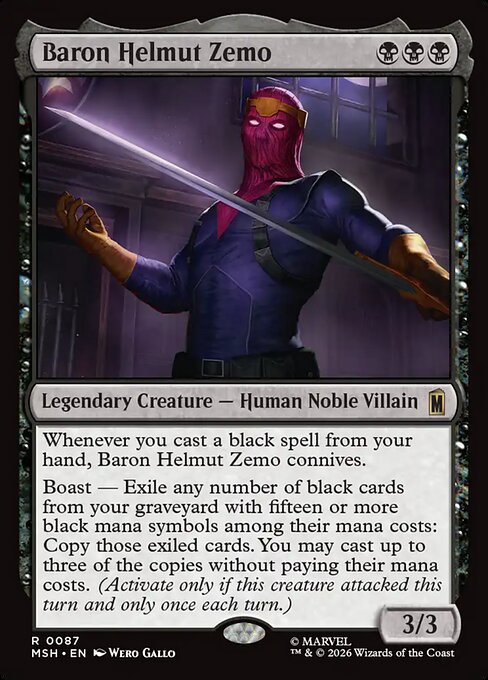 Baron Helmut Zemo
 Hawkeye, Master Marksman
 Reptil, Dinomorpher
 Storm, Force of Nature
 Baron Strucker, HYDRA Overlord
 Return to the Ranks
 Captain Mar-Vell, Space-Born
 Counterspell
 Falcon's Wing Harness
 Super Strength
 Dependable Quinjet
 S.H.I.E.L.D. Flying Car
 S.H.I.E.L.D. Helicarrier
 Viv Vision, Teen Synthezoid
 Borough Backup
 Kree Sentinel
 Black Widow, Double Agent
 Cloak and Dagger, Entwined
 Crossbones, Malicious Mercenary
 Hydraulic Helper
 Invisible Woman, Sue Storm
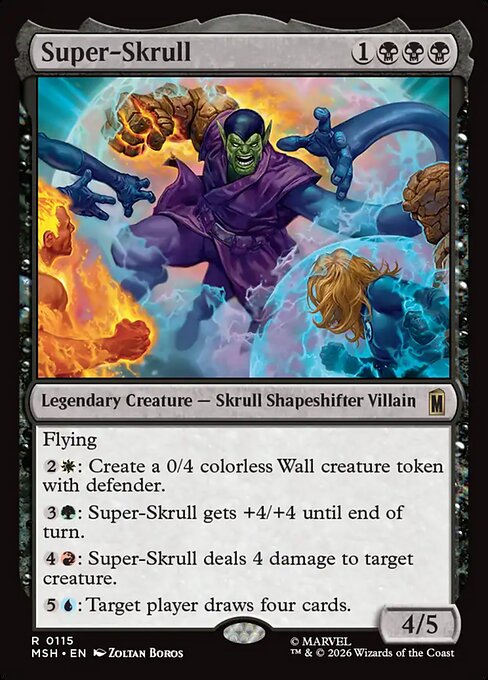 Super-Skrull
 Dig Through Time
 The Vision
 M.O.D.O.K.
 Avengers Disassembled
 Beast Within
 Captain America, Super-Soldier
 Ravenous Tyrannosaurus
 Epic Fight
 Unnatural Growth
 Concerted Effort
 Mockingbird, Ace Agent
 Ms. Marvel, Kamala Khan
 Frozen in Ice
 Light of Promise
 Mechanized Production
 Bruce Banner // The Incredible Hulk
 Red Hulk
 Captain America's Shield
 Hawkeye's Bow
 Black Widow, Super Spy
 Blazing Crescendo
 The Kingpin of Crime
 Go Nuts!
 Grim Reaper, Lethal Legionnaire
 Thunderbolts Conspiracy
 Winter Soldier, Icy Assassin
 Black Panther, Wakandan King
 Avengers Assemble!
 Captain Marvel, Earth's Protector
 Seize the Day
 Archangel of Thune
 Aurelia, the Warleader
 Ant-Man's Army
 Heroic Feast
 Iron Man, Titan of Innovation
 Alien Invasion
 Daredevil, Man Without Fear
 Wolverine, Best There Is
 Wolverine, Fierce Fighter
 Atlantis Attacks
 Heroic Intervention
 Beast, Erudite Aerialist
 Bullseye, Death Dealer
 The Unbeatable Squirrel Girl
 Arc Reactor
 Ironheart, Clever Champion
 Claim the Kingdom
 Ghost, Spectral Saboteur
 Agent 13, Sharon Carter
 Panther Pounce
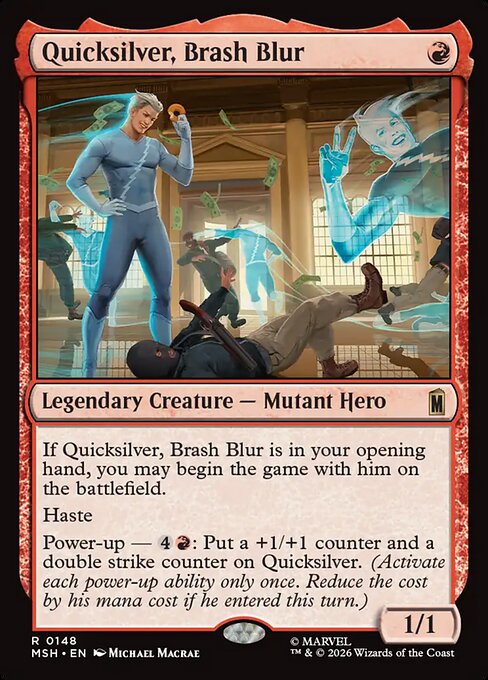 Quicksilver, Brash Blur
 Ka-Zar of the Savage Land
 Mole Man, Moloid Master
 Murdock's Crusade
 Brave Brawler
 Agents of HYDRA
 Arnim Zola, Bio-Fanatic
 Avengers: Under Siege
 HYDRA Troopers
 Rapid Rescue
 Jennifer Walters // The Sensational She-Hulk
 Spider-Man, To the Rescue
 Taskmaster, Mercenary Mimic
 Death to Our Enemies
 Sundering Growth
 Bold Biochemist
 Agent of Atlas
 Crimson Operative
 Kree Commandos
 Guerrilla Gorilla
 Ephemerate
 Monstrous Rage
 Armor Wars
 Origin of the Avengers
 Colleen Wing, Street Samurai
 Political Triumph
 Quake, Agent of S.H.I.E.L.D.
 Dauthi Voidwalker
 Elektra, Daughter of the Hand
 Klaw, Sonic Subjugator
 Final Showdown
 Three Steps Ahead
 Jessica Jones, Private Eye
 A.I.M. Synthoids
 Hour of Defeat
 A.I.M. Labs
 Agent Maria Hill
 Agent Phil Coulson
 Cruel Alliance
 Deadly Dispute
 Fiery Emancipation
 Luke Cage, Power Man
 Absorbing Man
 Atlantean Cavalry
 Captain America, Wings of Freedom
 Cosmic Cube
 The Wondrous Wasp