Goblin-town Flunkies
1RCreature
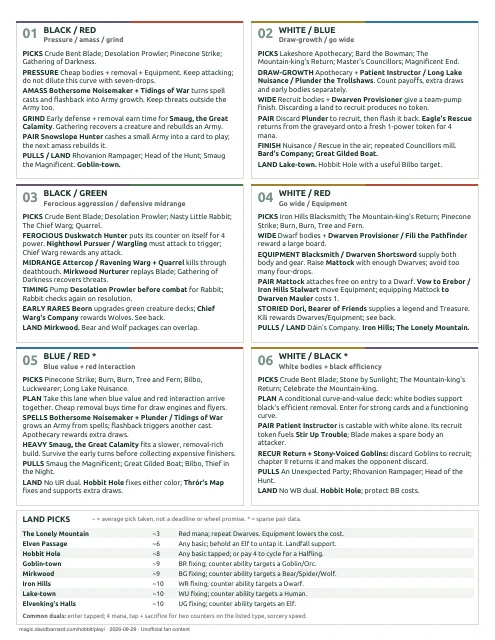
Rehearse a pick, take a sheet with you, and watch the videos worth your time.
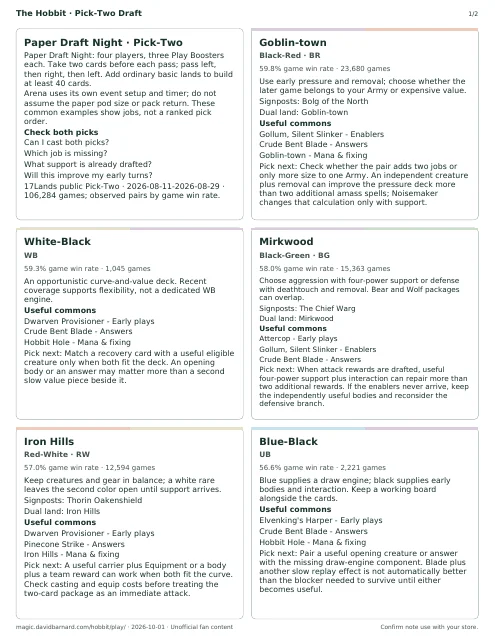
Packs are dealt from validated Play Booster slotsChoose two cards together. Name each card’s job, the support it needs, and the cards you would hope to see next.
Not an odds simulation or a recorded draft · Wizards: Collecting The Hobbit ↗
Recorded Pick-Two decisions, dated and timestamped.
Pick-Two Draft
After opening Bard’s Company and Goblin Plate Mail, Numot takes Mirkwood Pathmaker as his strongest option. For the second card, he compares several playables and chooses Plunder the Trollshaws to preserve a possible blue-white deck. The lesson: let an early card break a close comparison without treating it as a commitment.
 Bard's Company
 Goblin Plate Mail
 Mirkwood Pathmaker
 Plunder the Trollshaws
 Dreaded Bat-Cloud
 Bifur, Melodic Rider
 Long Lake Nuisance
Pick-Two Draft
With a mostly blue-white pool in pack three, Numot checks his existing draw effects before accepting Lakeshore Apothecary’s payoff. He then explains why he prefers another Velvetwing Butterflies to Dwarven Shortsword. The lesson: evaluate a conditional card against what you already drafted, and make the second pick serve that deck too.
 Lakeshore Apothecary
 Velvetwing Butterflies
 Dwarven ShortswordPlunder the Trollshaws
 Patient InstructorBard's Company
 Thrór's Map
 Bilbo Baggins, Burglar
 Confusticate and Bebother
The pack, drafted support and narrated comparison were reviewed; the final selection click was not observed.
Print at actual size. For the fuller explanations, keep Color pairs or Mechanics open on your phone.
Start with the first two. Use the long reviews only for a color or an interaction you want to understand better.

Learn the recurring mechanics and what the colors are trying to do. This is an early-format overview; use the later deck lessons for developed strategy.

Marshall Sutcliffe and Paul Cheon’s late-format conversation. Listen for support, coherent decks, and why a card’s role matters more than a blanket ranking.
The conversation includes Sealed experience; these selected jumps are not recorded draft picks.
The deck plans draw on late-format draft guides and discussions. The step-by-step lessons apply those ideas to the actual card text. Exact card pairings are examples, not measured combination win rates.